
Missing Documents for German Citizenship by Descent? We Trace Historical Records in Germany and Abroad
For Many Families, German Citizenship Is More Than a Passport
It represents a connection to family history, an opportunity for future generations and, in many cases, the fulfilment of a long-held family ambition.
Yet an application can come to a standstill because a single historical record cannot be found: a birth certificate, a marriage entry, a naturalisation file or evidence showing where an ancestor lived.
Our German-based investigators specialise in tracing specific historical records when routine enquiries and conventional archive searches have reached their limits. We research in Germany and, where necessary, coordinate enquiries with trusted local investigators and specialist researchers abroad.
Having German ancestors does not by itself establish German citizenship. The relevant documents must also show that German nationality existed and was transmitted under the law applicable at the time. We do not provide legal advice or decide whether an applicant qualifies. Our role is to search for missing documentary evidence and document the results of our enquiries; we do not interpret the law.
Why Choose Our Investigative Research Service?
- German case management in English or German
- Experience communicating with registry offices, archives and church authorities
- On-site research where relevant holdings cannot be examined remotely
- International coordination with trusted local investigators and specialist researchers
- Support for private applicants, attorneys and immigration professionals
- Discreet handling of personal and historical family information
When a Missing Record Delays Your Application
Applicants living abroad whose cases are handled by the Federal Office of Administration (Bundesverwaltungsamt – BVA) may need to document several generations of their family line. The exact evidence required depends on the legal route and the individual circumstances.
Records commonly relevant to these proceedings include:
- Birth and parentage records – Used to document identity and the connection between generations
- Marriage and name-change records – Relevant where marriage, parentage or a change of name affects the documentary chain
- Historical evidence of German nationality – May include older German passports, nationality or citizenship certificates, registration records or other official documents containing relevant nationality information
- Naturalisation records from another country – Often important in historical cases because the date and circumstances under which an ancestor acquired another nationality may affect whether German citizenship was retained or lost under the law applicable at that time
- Population and registration records – May provide addresses, family relationships, nationality entries and clues to the competent registry office
- Church registers (Kirchenbücher) – Often an important source for baptisms and corresponding birth details, marriages and burials before civil registration was fully established
- Emigration and passenger records – May include passenger lists, departure registers and applications to emigrate
- Supplementary military, residence or archival records – May help reconstruct relevant facts where primary civil-status records are unavailable
Often, the required record has not disappeared. It may be held by a different institution, registered under another spelling, filed under an earlier administrative district or located in a country that now covers the ancestor’s former place of residence.
This is where documentary research becomes an investigation.
Why Historical German Records Can Be Difficult to Find
The Exact Place of Registration Is Unknown
There is no central civil registry in Germany. Each Standesamt (civil registry office) holds records only for events that occurred within its jurisdiction. If the exact municipality is unknown, individual registry offices can normally search only the registers within their own jurisdiction. They are not a nationwide search service and generally cannot investigate numerous possible locations on the applicant’s behalf.
Names and Spellings Changed
Surnames changed through later adaptation, inconsistent spelling, translations or entries in different official documents. Passenger lists, naturalisation records and civil documents may all show different spellings of the same family name.
Municipal and Administrative Structures Changed
Villages have been absorbed into larger municipalities. Records may have been transferred to another registry office or archive, while incomplete historical documentation can make their current location difficult to determine.
Borders and Jurisdictions Changed
Germany’s borders have changed multiple times in the last 150 years. Records that were once in German archives may now be held in Polish, Czech, French or Russian archives—and may be catalogued under the successor jurisdiction’s administrative system.
Registers Were Transferred
German civil registers are maintained by registry offices for statutory periods: 110 years for birth registers, 80 years for marriage and civil-partnership registers, and 30 years for death registers. Once the applicable period has expired, the records may be transferred to the competent municipal, district or state archive, depending on local and state rules. A successful search therefore often begins by determining which institution currently holds the relevant register.
Collections Were Damaged or Lost
War, fire and displacement caused substantial losses in some regions and cities. However, the extent of surviving records varies considerably by location, period and type of register. Many records that initially appear unavailable have instead been transferred, indexed under an earlier place name or catalogued in a way that makes them difficult to locate.
When Archive Research Becomes an Investigation
Sometimes the missing document is not the real problem.
Sometimes nobody knows:
- where the ancestor lived
- which surname they originally used
- whether they ever became naturalised
- whether they travelled or were recorded under a different name or spelling
- which archive now holds the records
This is where archive research becomes investigation. We do not simply look for documents in obvious places—we follow leads, reconcile conflicting information and identify potential sources that may not appear in a straightforward name-based catalogue search.
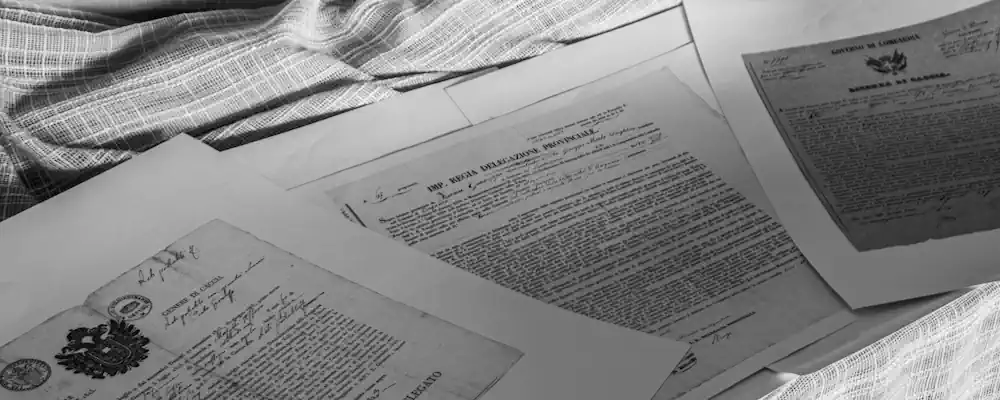
How Our Investigators Search for Missing Records
- Document Assessment
We review the information you already have—names, dates, places and any existing documentation. We identify which records are missing and what research strategy is most likely to succeed. - Jurisdiction Research
We determine which archives, registry offices or church authorities are likely to hold the relevant records based on the period, location and type of document. - Archive Enquiries
We contact archives, registry offices and church authorities. Archive enquiries usually need to identify a specific person, place, period or collection. Where the available information is incomplete or contradictory, preliminary investigative research may be required before a meaningful archive request can be submitted. - International Coordination
Where research abroad is required, we coordinate with trusted local investigators and specialist researchers in the relevant country. - On-Site Research Where Necessary
When relevant holdings cannot be examined remotely, our investigators or local research partners can attend archive reading rooms and other repositories in person, subject to the institution’s access rules. - Documented Results
We organise the located records and provide documentation of our research so that you or your legal adviser can review them for submission to the competent authority.
Typical Situations in Which Professional Research May Help
The Ancestor’s Birthplace Is Unknown
A family knows their German ancestor was born “somewhere in Bavaria.” No specific town. No registry district.
How we approach it: We cross-reference emigration records, passenger lists and naturalisation documents to establish the ancestor’s probable birthplace. Once we identify likely regions, we conduct targeted searches of church records (Kirchenbücher) and Standesamt registers.
The Record Is Held in a Former German Territory
The ancestor was born in a territory that is no longer part of Germany—perhaps in what is now Poland, France or the Czech Republic.
How we approach it: We research which present-day registry office or archive is likely to hold the relevant records and determine how an enquiry can be made. Depending on the place, year and type of event, relevant records may be held by the Standesamt I in Berlin, the Berlin State Archive, a present-day registry office or an archive in Poland or another successor state.
The Family Name Changed After Emigration
The family surname was recorded differently in passenger lists, naturalisation records and civil documents. The original German spelling may be uncertain.
How we approach it: We use phonetic searching, alternative spelling variants and cross-referencing techniques to match historical records with your family’s information.
The Original Register Was Damaged or Lost
War, fire, flood or improper storage has made some records difficult to access.
How we approach it: We search for surviving duplicates, parallel records and secondary sources that may contain the same or corroborating information. This can include church registers, population records, military files or other archival material connected to the person or place concerned.
The Relevant Records Were Transferred
A church register or civil record was transferred from the institution that originally created it to another church, municipal or public archive. Historical finding aids do not always make the present location immediately apparent.
How we approach it: We reconstruct the administrative or institutional history of the record and identify the authority or archive that is now likely to hold it.
Only Limited Family Information Is Available
The applicant has a photograph, a family story or minimal documentation. No official records remain in the family.
How we approach it: A photograph can be useful when it contains an inscription, photographer’s mark, studio location, uniform, address or other identifiable detail. A photograph without any contextual information will rarely be sufficient on its own, but it may still be reviewed together with other family information.
What Our Service Does—and Does Not—Include
Our Service Includes
- Archive research in Germany – Systematic searches of German archives, registry offices and church records on your behalf
- On-site investigations – In-person research where relevant holdings cannot be examined remotely, subject to institutional access rules
- International record tracing – Coordination with trusted local investigators and specialist researchers in the relevant country
- Historical address research – Examining available registration and address records to identify former residences and the authorities responsible for related records
- Alternative evidence gathering – Searching passenger lists, military records, census data and other supplementary sources
- Research documentation – Providing organised records and documentation of our search process
Our Service Does Not Include
We do not provide legal advice on German nationality law. That is the domain of attorneys specialising in citizenship matters. We search for missing documentary evidence and document the results of our enquiries; we do not interpret the law. Whether a particular document or combination of records will be sufficient for a specific citizenship procedure must be assessed by the competent authority or a qualified legal adviser.
We are not conventional genealogists building family trees. Our service is not standard family-history research. We focus on locating specific records and verifiable evidence needed for citizenship, inheritance and other official proceedings. We use genealogical research methods, but our goal is evidence gathering, not narrative family history.
We do not have privileged access to protected records. We do not have special access rights to restricted records. However, we understand the applicable procedures, including statutory retention periods, archival protection rules and proof-of-relationship requirements. Where the legal requirements are met, we can conduct enquiries on the client’s behalf with the necessary authorisation.
Who We Assist
- Private individuals applying for German citizenship by descent or declaration
- Attorneys and immigration professionals who need specialised investigation services for their clients
- Families seeking to resolve inheritance matters that require official proof of descent
- Researchers who have reached the limits of conventional archive research
You may instruct us directly or through your attorney or legal adviser. We handle the research; questions of eligibility and the application itself remain with the competent authority or your legal representative.
Frequently Asked Questions
My grandfather was born in Germany. Where do I start with my German citizenship application?
What information should I send for an initial assessment?
What if nobody knows where my ancestor was born?
Can you search in former German territories?
Can you search German church records?
What if my ancestor changed his surname?
Can you help if I only have a photograph?
How long does an investigation take?
What if the documents were destroyed?
What if an archive or registry office confirms that no record can be found?
Can you help me search for records from former German eastern territories?
Do you speak German?
What Makes Us Different
- German case management – Your case is managed by a German-speaking team with direct experience of German archival systems and procedures
- On-site and cross-border capability – We conduct in-person research where necessary and coordinate with trusted local investigators and specialist researchers in the relevant country
- Focus on specific documentary objectives – We locate verifiable documentary evidence for official proceedings, not narrative family history
- Transparent assessment of difficult cases – We provide honest assessments of whether a professional search appears promising and explain the likely cost and timeframe
We understand how to determine which archive or authority is likely to hold a particular record and how to pursue the search across changing jurisdictions.
Ready to Find What’s Missing?
Your German citizenship application does not have to end with a missing document. Many records that appear “lost” are simply difficult to locate—and that is exactly what we do.
Send us the ancestor’s name, approximate date and place of birth, known relatives, emigration details and copies of any records already available. We will assess whether a professional search appears promising and provide a transparent proposal for the next steps.
Contact Us — Let’s locate your missing records.
+49 – 2369 – 20 30 0
We assist private applicants, attorneys and immigration professionals with difficult historical record searches in Germany and abroad.

Please contact our detective agency.
We'll be happy to assist you.